
In the transportation of cryogenic liquids, vehicle weight, payload capacity and operational safety are important considerations for fleet operators and logistics companies. As transportation businesses look for ways to improve load efficiency and reduce operating costs, Beamless LOX tanker trailer designs have attracted increasing attention.
One design approach is the beamless, self-supporting tank structure, which reduces the need for a conventional external chassis frame by allowing the tank assembly to participate in carrying structural loads.
However, liquid oxygen (LOX) is a cryogenic medium stored at approximately -183°C under specially designed insulation and pressure conditions. Removing the traditional main beams raises an important engineering question: How can a beamless LOX tanker trailer maintain sufficient structural strength while achieving a lower overall weight?
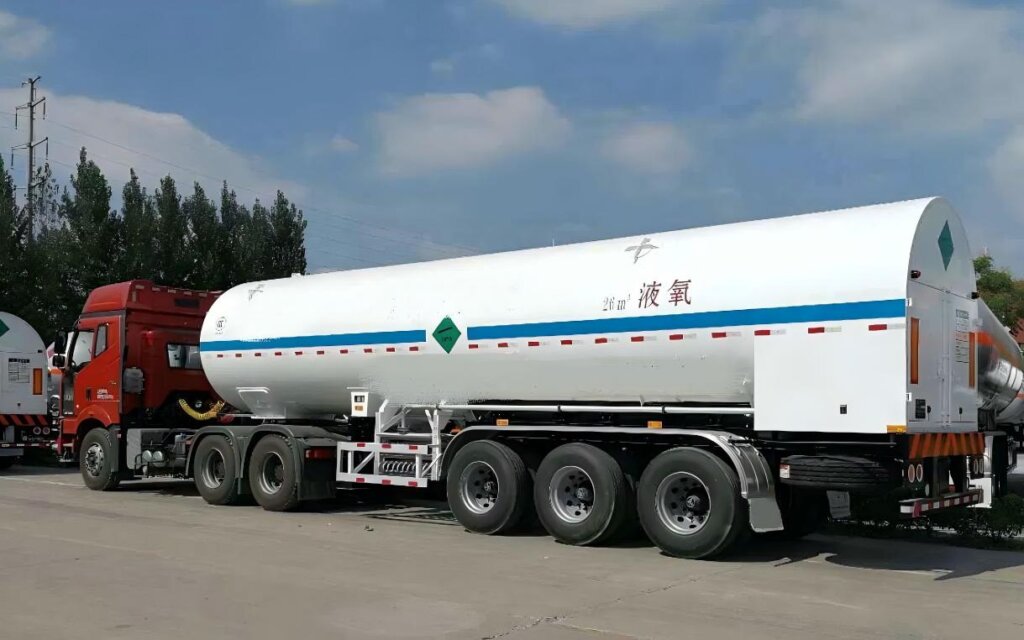
Why Are Beamless Structures Used in LOX Tanker Trailers?
Traditional tanker trailers generally consist of a tank assembly mounted on a separate chassis frame. While this arrangement provides a clear load-bearing structure, it also introduces several design considerations.
①Additional structural weight
The separate chassis frame, mounting supports and connecting components add to the vehicle’s tare weight. For cryogenic tanker trailers, reducing unnecessary structural weight can help improve payload efficiency, provided that all applicable safety and design requirements are maintained.
②Complex load transfer
In a conventional design, loads are transferred through several structural interfaces between the tank supports and the main chassis. These connection areas require careful engineering to manage bending forces, vibration and repeated road impacts.
③More structural components to inspect
Mounting brackets, fasteners and support connections require regular inspection. Their condition is particularly important for vehicles operating over long distances and under demanding road conditions.
A beamless design takes a different approach. Instead of relying entirely on two conventional longitudinal chassis beams, it integrates selected structural components with the tank assembly. The tank structure and supporting members work together as part of the vehicle’s load-bearing system.
This approach can reduce redundant structural weight and simplify certain parts of the overall arrangement. However, it requires careful structural calculations, material selection and manufacturing control.
How Does the Tank Structure Carry Vehicle Loads?
A beamless tanker trailer does not simply use a cylindrical tank as a direct replacement for two chassis beams. Its strength comes from an integrated structural design in which different components perform specific functions.
The cylindrical shell provides useful structural characteristics. Its closed cross-section offers good resistance to torsional deformation, while its large section geometry helps distribute certain bending loads.
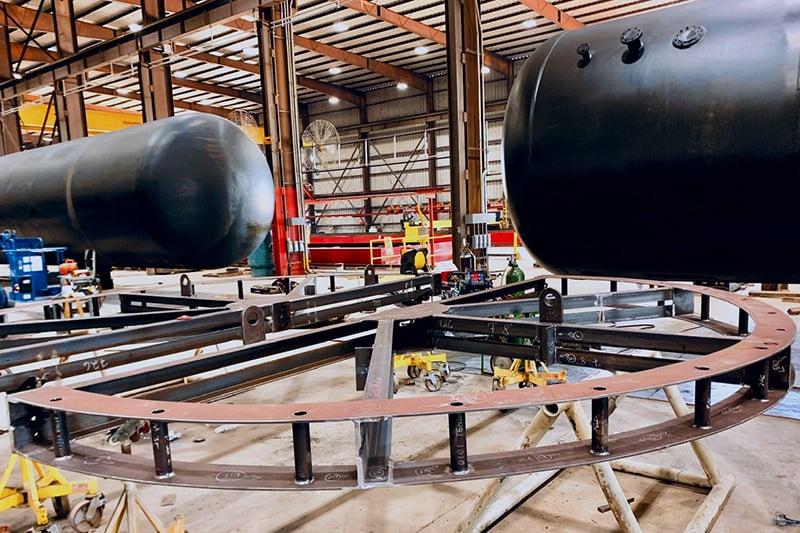
Supporting structures such as saddles, reinforcing rings, bulkheads and specially designed connection members help transfer loads through the tank assembly and suspension system.
The main engineering objective is to distribute forces rather than concentrate them at a few connection points.
For example:
- Saddles and support members** help transfer loads between the tank assembly and the running gear.
- Reinforcing rings** improve local shell stiffness and help control deformation.
- Internal structural components** contribute to load distribution and shell stability where required by the design.
- Suspension connection areas** need sufficient reinforcement to withstand dynamic loads generated during driving.
The traditional design can be described as a tank supported by a separate frame. In an integrated beamless arrangement, the tank assembly becomes part of the overall load-bearing structure.
The success of this design depends on the strength and coordination of the entire structural system, not on the tank shell alone.
Special Engineering Challenges of Cryogenic LOX Tankers
Compared with ordinary liquid tanker trailers, LOX tankers require additional attention because of their extremely low operating temperature and vacuum insulation system.
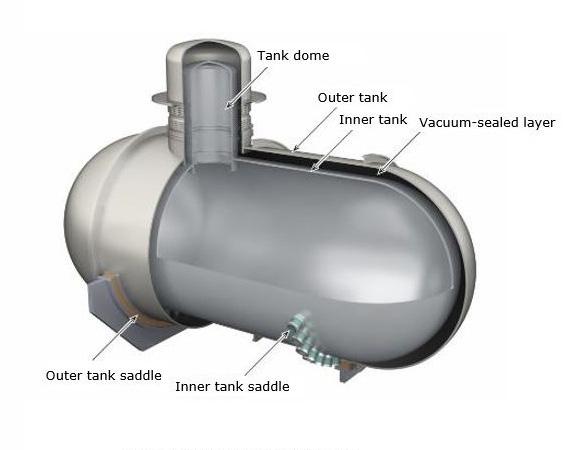
A typical cryogenic tank uses a double-wall construction consisting of an inner vessel, an insulated vacuum space and an outer jacket. Each component has a different engineering responsibility.
Different Structural Functions of the Inner and Outer Vessels
The inner vessel is designed to contain liquid oxygen under the specified operating pressure and cryogenic conditions. The outer jacket provides protection for the insulation space and is designed to withstand external atmospheric pressure caused by the vacuum environment, as well as applicable mechanical loads.
The two vessels therefore have different material, strength and deformation requirements.
Material Selection for Extremely Low Temperatures
The inner vessel generally uses suitable austenitic stainless steel grades because of their ability to retain good toughness at cryogenic temperatures.
Material selection must consider more than tensile strength. Low-temperature impact toughness, weldability, compatibility with the stored medium and applicable pressure vessel standards are all important factors.
Controlling Deformation in the Vacuum Insulation Space
The inner and outer vessels are separated by a vacuum insulation space and connected through specially designed support systems.
Excessive deformation of the outer jacket or supporting components may affect the insulation arrangement and introduce unwanted loads into the system.
For this reason, structural stiffness and deformation limits must be considered during the design process. The vacuum insulation system must remain protected throughout normal operation and the expected service life of the trailer.
Three Key Approaches to Combining Lightweight Design with Structural Strength
Achieving a lightweight LOX tanker trailer is not simply a matter of reducing plate thickness. It requires coordinated optimization of materials, structural layout, engineering analysis and manufacturing processes.
Selecting Materials According to Their Functions
Different components operate under different conditions, so material selection should be based on their actual engineering requirements.
Outer jacket: Suitable structural steel can be selected according to external pressure, mechanical loading, corrosion protection and manufacturing requirements.
Inner vessel: Cryogenic-grade stainless steel is commonly used to provide the required low-temperature toughness and pressure containment performance.
Reinforcing components: Local reinforcements can be applied to areas subject to higher loads instead of increasing material thickness across the entire structure.
This targeted approach helps balance structural performance and overall weight.
Optimizing Reinforcement Distribution
Reinforcement should be arranged according to the actual load distribution of the tank assembly.
For example, areas around the main support connections and suspension interfaces may experience relatively high local stresses. Reinforcing rings, support plates and additional structural members can be introduced where engineering analysis identifies the need.
The objective is to distribute concentrated forces over a larger structural area and reduce local stress concentrations.
Rather than adding excessive material everywhere, a well-designed structure places reinforcement where it provides the greatest benefit.
Applying Engineering Analysis and Controlled Manufacturing
Computer-aided engineering tools, including finite element analysis (FEA), can help evaluate stress distribution, deformation and structural behavior under different loading conditions.
These calculations should be supported by appropriate manufacturing and inspection procedures.
Important manufacturing considerations include:
- Controlled welding procedures for longitudinal and circumferential welds.
- Qualified welding personnel and suitable inspection methods.
- Dimensional checks to verify the accuracy of the inner and outer vessel assemblies.
- Pressure, leak-tightness and vacuum-related tests according to the applicable design and certification requirements.
- Inspection of critical structural connections and reinforced areas.
For cryogenic pressure vessels, the specific testing procedures must follow the applicable pressure vessel codes and approved design documentation. Structural strength, pressure integrity and vacuum performance all require independent verification.
What Should Buyers Consider When Choosing a Beamless LOX Tanker Trailer?
For international buyers and fleet operators, a lightweight design should never be evaluated by tare weight alone.
Several factors deserve attention before selecting a beamless cryogenic tanker trailer:
Structural design and engineering documentation
Ask about the tank structure, load-bearing arrangement, material specifications and applicable design standards.
Cryogenic performance
Check whether the inner vessel materials and insulation system are suitable for the intended liquid oxygen operating conditions.
Manufacturing and inspection capabilities
Reliable welding procedures, qualified inspection processes and documented pressure vessel testing are essential for cryogenic equipment.
Operating conditions
Road conditions, route distances, loading requirements and local regulations should all be considered when determining the appropriate trailer configuration.
A well-engineered tanker should provide a practical balance between weight reduction, structural reliability, insulation performance and long-term operating requirements.
Conclusion
Lightweight design in beamless LOX tanker trailers is a comprehensive engineering task. It involves more than removing conventional chassis beams or reducing steel thickness. The tank assembly, support structures, materials, insulation system and manufacturing processes must work together as an integrated system.
When properly engineered and manufactured, a beamless structure can help reduce unnecessary vehicle weight while maintaining the structural performance required for cryogenic transportation.
At FUYUE, we focus on trailer manufacturing and transportation equipment solutions for international markets. We believe that reliable tanker trailer performance begins with sound engineering, appropriate material selection and consistent manufacturing quality.
Looking for a suitable tanker trailer for your transportation business? Contact FUYUE to discuss your application requirements and trailer configuration.