
Skeleton Trailer
Skeleton Trailers Built for Efficient Container Transportation
FUYUE Skeleton Trailers are designed for transporting standard shipping containers between ports, container terminals, warehouses and logistics facilities. The open chassis structure provides a practical platform for container transportation, while container twist locks help secure containers during transit. Available in different chassis lengths, axle configurations and component options, FUYUE Skeleton Trailers support a range of container handling and transportation requirements.
Lightweight Chassis Design
Efficiency
Reliable Container Locking
Security
Stable Road Performance
Stability
Flexible Container Transport
Versatility
What Makes a Skeleton Trailer Practical?
Designed for Everyday Container Transportation
Open Chassis Structure
The skeletal frame supports shipping containers without the weight and bulk of a full flatbed platform.
Secure Container Locks
Twist locks are positioned to secure compatible containers during transportation.
Multiple Container Configurations
Chassis configurations can accommodate specified container sizes and arrangements, depending on the trailer design.
Durable Main Frame
The chassis is designed to support container loads during regular transportation operations.
Reliable Running Components
Axles, suspension and braking systems support stable operation under suitable loading conditions.
Port and Logistics Applications
Suitable for container movement between ports, terminals, distribution centers and warehouses.
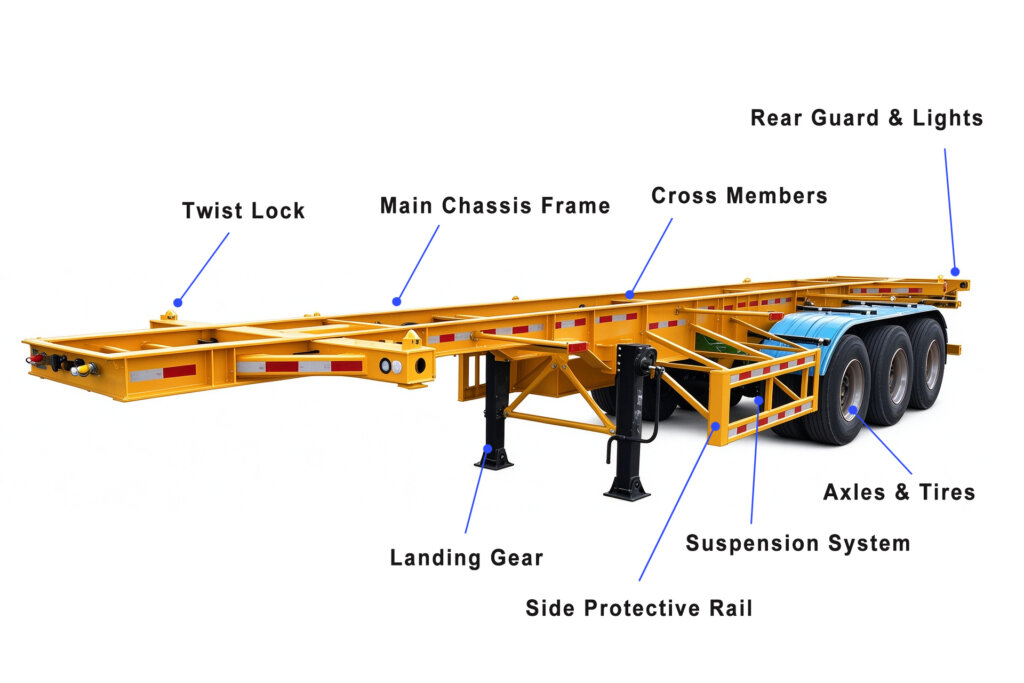
Skeleton Trailer Structure
Key Components for Reliable Container Transport
Skeleton Trailer Specifications
Practical Configurations for Container Transportation
Item | Specification |
Manufacturer | QINGDAO FUYUE VEHICLE CO., LTD |
Model number | FY9352TJZG/FY9351TJZG/FY9401TJZ/FY9402TJZG/FY9404TJZG/FY9405TJZG/FY9406TTJZG/FY9401P |
Tare weight | About 6.2T |
Dimension | 12400mm*2500mm*1575mm |
Loading capacity | 30-45T |
Axle | 13T/16T, FUWA/BPW Brand |
Rim | 9.00-22.5/8.00-20/8.5-20 |
Tire | 12.00R22.5/315 80R22.5/11.00R20/12.00R20 Brand can be optional |
Suspension | Mechanical suspension (Germany Type or America Type) or Air suspension |
Spring leaf | 90(W)mm*13(Thickness)mm*10 Layer (Especial for exporting market) |
King pin | JOST brand 2.0 or 3.5 inch |
Support leg | JOST brand |
Main beam | Height: 500mm, upper plate is 14mm, middle plate is 8mm, Down plate is 16mm; Mater is Q345B steel. |
Side beam | 16mm channel steel (Material is Q235 steel) |
Bottom platform | 3mm diamond steel plate |
Brake chamber | WABCO RE6 relay valve; T30/30+T30 spring brake chamber; Two pieces of 45L air tanks |
ABS | Optional |
Twist locks | Four, eight or twelve pieces (Lifting type or twist screw type) |
Valve | WABCO valve (especial for exporting market) |
Light | LED light (especial for exporting market) |
Voltage | 24V |
Receptacle | 7 ways (7 wire harness) |
Tool box | One piece, 1m*0.5m*0.5m (Size can be choose freely) (equipped with 1 unit tire spanner, 1 unit gudgeon sleeve and 1 unit cranking bar) |
Painting | Complete Chassis sand blasting to clean rust, 1 coat of anticorrosive prime, 2 coats of final paint |
Shipping terms | By bulk cargo carrier, RORO or 40HQ container |
* Specifications may vary according to trailer configuration, cargo requirements and destination-market regulations.
Skeleton Trailer Gallery
See FUYUE Skeleton Trailers in Different Configurations
Applications
Built for Different Container Transportation Needs
Port & Container Terminal Logistics
Skeleton Trailers are widely used to move shipping containers between port terminals, container yards and nearby logistics facilities. The chassis and locking system are designed for compatible containers and regular terminal transportation operations.
Inland Container Transportation
Skeleton Trailers support container transportation between ports, warehouses, distribution centers and industrial facilities. Suitable chassis configurations help accommodate container dimensions and operating requirements for regional and long-distance transport.
Skeleton Trailer FAQ
Find Answers About Container Compatibility, Configurations and Transportation.
What is a skeleton trailer used for?
A skeleton trailer is designed primarily for transporting shipping containers. Its open chassis supports the container at designated points, making it suitable for port logistics, container terminals, warehouses and inland transportation.
What is the difference between a skeleton trailer and a flatbed trailer?
A skeleton trailer uses an open frame designed specifically for supporting shipping containers. A flatbed trailer has a full platform that can carry containers when equipped with suitable locking devices, as well as other types of general cargo.
What container sizes can a skeleton trailer carry?
Depending on the chassis design, skeleton trailers can be configured for compatible standard containers, including 20FT and 40FT sizes. Confirm the intended container dimensions and locking positions when selecting a trailer.
How are containers secured on a skeleton trailer?
Compatible container twist locks secure the container to designated points on the chassis. The locking arrangement must match the container size and trailer configuration, and all locks should be properly engaged before transportation.
What axle configurations are available for skeleton trailers?
Axle configurations vary according to load requirements, chassis design and destination-market regulations. Common options include 2-axle, 3-axle and other configurations for specific operating requirements.
How much weight can a skeleton trailer carry?
Payload capacity depends on the chassis structure, axle configuration, tare weight, container and cargo weight, and applicable road regulations. The actual permitted load should be confirmed for the intended market and operation.
Can a skeleton trailer transport both 20FT and 40FT containers?
Some configurations support both sizes through appropriately positioned container locks. Compatibility depends on the chassis design, locking positions and specified container arrangement.
What should I consider when choosing a skeleton trailer?
Consider container size, required load capacity, chassis configuration, axle arrangement, suspension, braking system, road conditions and destination-market regulations. These factors help determine a suitable trailer configuration.
Is a skeleton trailer suitable for long-distance container transportation?
Yes. Skeleton trailers can be used for regional and long-distance container transport when the trailer, container load, tractor combination and operating conditions comply with applicable requirements.
What maintenance does a skeleton trailer require?
Routine maintenance includes inspecting the chassis frame, container locks, axles, suspension, tires, braking system, landing gear and kingpin. Regular inspections help identify wear or damage and support reliable operation.
Explore More Trailer Types
Explore other FUYUE semi trailers designed for different cargo and transportation requirements.
Flatbed Trailer
Flatbed Trailer
Fuel Tank Trailer
Fuel Tank Trailer
Low Bed Trailer
Low Bed Trailer
Gas Tank Trailer
Gas Tank Trailer
Cargo Trailer
Cargo Trailer
Dump Trailer
Dump Trailer
Your Requirements. Our Manufacturing.
Every market and transportation application is different. That’s why we offer customized trailer configurations based on your cargo, payload, dimensions, road conditions and local requirements.
Whether you need a standard trailer or a specially configured solution, our team can work with you to determine the appropriate structure, axle configuration, suspension, braking system and other specifications.